
EMS Power Control Blueprint
From 3.7V to 80V: Complete EMS Device Power & Control Blueprint

Introduction
Modern EMS (Electrical Muscle Stimulation) training devices demand precision, safety, and performance. This guide shows you exactly how to transform a 3.7 V Li-ion battery and an ESP32-S3 microcontroller into a safe, high-voltage EMS output system capable of delivering adjustable, isolated pulses up to ~80 V under load.
We’ll explore the power conversion steps, control logic, safety features, and real-world testing approaches — from breadboard prototypes to production-ready designs.
1. Understanding the Core Challenge
The ESP32-S3 outputs a 3.3 V PWM signal — perfect for control, but not enough to directly drive the muscle stimulation load. An EMS output requires:
-
Higher voltage: Typically 50–80 V peak under load for effective muscle activation.
-
Strict current control: To remain within safe, comfortable limits.
-
Precise pulse shaping: Adjustable frequency, pulse width, ramps, and duty cycle for different training modes.

2. Two Proven Power Conversion Topologies
Option A — Two-Stage Conversion (Recommended)
-
Stage 1: 3.7 V → 12 V Boost Converter
-
Steps battery voltage to a stable intermediate bus voltage.
-
Improves efficiency and reduces current stress on components.
-
-
Stage 2: 12 V → 80 V High-Voltage Pulse Stage
-
Uses a transformer H-bridge or flyback topology.
-
Rectifies and shapes pulses for the EMS load.
-
Includes current limiting and isolation.
-
Advantages:
-
Lower peak currents in the HV stage.
-
Easier transformer design.
-
Better thermal performance.
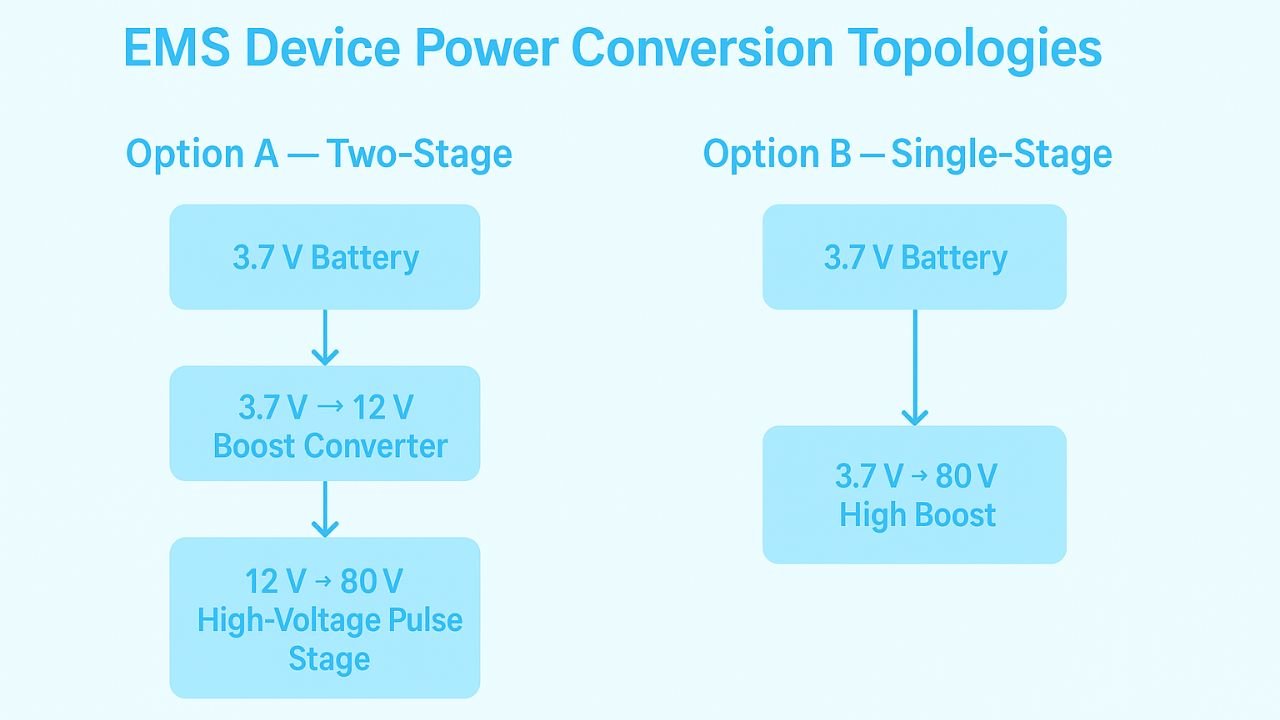
Option B — Single-Stage High Boost
-
Directly converts 3.7 V to ~80 V in one step using a boost or flyback converter.
-
Fewer components but higher switch currents and more challenging EMI control.
When to use:
-
Ultra-compact designs with lower power requirements.
-
Prototypes where simplicity outweighs efficiency.
| Stage | Component | Role |
|---|---|---|
| Control | ESP32-S3 | Generates PWM with all training parameters. |
| Driver | Gate Driver / Isolator | Amplifies PWM control to drive MOSFET gates safely. |
| Switching | Logic-level MOSFET | Handles high currents to energize transformer or inductor. |
| Voltage Boost | DC-DC Converter / Transformer | Steps voltage up to intermediate or final HV. |
| Rectification | Fast HV Diode | Converts AC pulses to DC pulses. |
| Energy Storage | HV Capacitor | Shapes and stabilizes output pulses. |
| Safety | Current-Limiting Resistor | Caps maximum output current for user safety. |
4. Safety Considerations
EMS devices interact with the human body — safety is non-negotiable:
-
Current Limiting: Keep output current within IEC 60601-2-10 safe limits.
-
Isolation: Maintain electrical separation between mains/battery and electrodes.
-
Pulse Energy Control: Short pulse durations and controlled duty cycles.
-
Dummy Load Testing: Never test high-voltage output on the human body during development.
5. Adjustable Training Parameters
Once parameters are set at the start of a workout, they remain locked — only Intensity (0–100%) can be adjusted during the session. Adjustable before locking:
-
Pulse Time (s): 1–99
-
Pause Time (s): 0–99
-
Workout Duration (min): 0–60
-
Frequency (Hz): 1–120 (steps of 1 Hz below 10 Hz, 5 Hz above)
-
Pulse Width (µs): 50–500 (step 5 µs)
-
Ramp-Up / Ramp-Down (0.1 s units): 0–50
6. From Breadboard to Production
Prototype Testing:
-
Use ESP32-S3 with breadboard, LED/resistor load, and oscilloscope to validate PWM parameters.
-
Simulate HV stage using MOSFET + dummy load at low voltage (e.g., 12 V).
Pre-Production Stage:
-
Build HV stage with transformer or boost converter.
-
Implement proper shielding, filtering, and thermal management.
Production Stage:
-
Enclose electronics in medically compliant housing.
-
Certify safety and EMC compliance.
-
Integrate with user interface and EMS suit/electrodes.
7. Why This Blueprint Works
-
Modular approach allows swapping power stages without changing control firmware.
-
Safety-first design aligns with international EMS standards.
-
Optimized for efficiency and reliability from a 3.7 V Li-ion source.
Simulate Circuite in Software
1. Professional Circuit Simulation (Accurate & Parameter-Specific)
LTspice (Free, industry standard)
-
What it does: Full SPICE simulation of analogue, mixed-signal, and switching power stages.
-
Accuracy: Very high for waveforms, voltages, currents, timing.
-
EMS fit:
-
You can model your boost converter, transformer stage, MOSFETs, and gate driver exactly.
-
Feed in your ESP32 PWM waveform as a source.
-
Measure ramp-up, duty cycle, HV pulse shape, and output current limits.
-
-
AI help: Not built-in, but you can pair it with ChatGPT (or similar) to auto-generate LTspice netlists or tweak component values.
PSpice (Paid, very detailed)
-
What it does: Industry-grade SPICE simulator with vast model libraries.
-
EMS fit: Detailed transient analysis, perfect for high-voltage pulse shaping and EMI predictions.
-
AI help: Cadence is integrating AI-assisted component suggestion and auto-optimization.
2. Power Electronics Focused
PLECS (Paid, but best for power converters)
-
What it does: Models power electronics + control loops very efficiently.
-
EMS fit: Ideal for modelling the two-stage (3.7 → 12 V → 80 V) EMS topology, transformer design, and load models.
-
AI help: Not direct, but can be paired with MATLAB AI scripts for automatic parameter sweeps.
3. AI-Driven Electronics Platforms
Autodesk Fusion 360 with Electronics + Generative Design
-
Combines PCB design, simulation, and AI-driven optimization for component layout and thermal design.
-
Can simulate your HV stage and optimize for size, efficiency, or safety margins.
Keysight PathWave ADS
-
High-end RF & power electronics simulation with AI-assisted optimization tools.
-
Can automatically tweak parameters to reach target voltage/current/frequency.
4. Hobbyist-Friendly (Faster Learning Curve)
| Tool | EMS Fit | AI Integration |
|---|---|---|
| Tinkercad Circuits (Free) | Basic low-voltage digital & analogue | No |
| EasyEDA (Free/Paid) | PCB + basic SPICE sim for LV | No |
| CircuitLab (Paid) | Intuitive browser-based SPICE | No |
| PSIM (Paid) | Power-focused, fast simulation | Limited via scripting |